The Vehicle of Travel
rcunico Comments 2 comments
1997 Honda Civic

Purchase and Repair Work
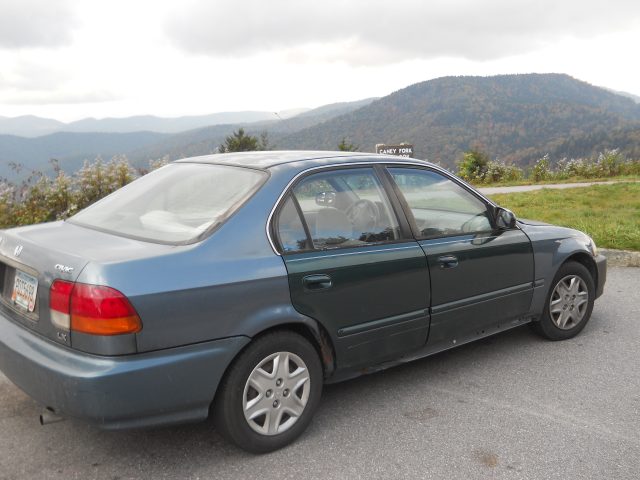
I figured I’d start out the blog with one of the most crucial pieces of this trip – the vehicle. We will be driving a 1997 Honda Civic, which I acquired last August for $1400. When I got the vehicle, it was in rough shape..saying it needed some TLC was an understatement. I wanted to get my hands dirty, and that’s what I did. Here’s what I did to get it road-worthy. Feel free to ask any questions you may have, especially if you are trying to plan some sort of long journey of your own!
The first thing I did was replace all 4 tires – and got an alignment. I decided to get the 3 year plan (which turned out to be worth its weight in gold as I continued to work on the suspension). I immediately changed the transmission fluid and oil.

Now allegedly there was some maintenance performed by the previous owner – CV axles, AC compressor, valve cover gasket, radiator, head gasket, front and rear brakes, and spark plugs/wires. But when you buy a used vehicle, you need to take all of that with a grain of salt. Don’t put too much faith in these claims, unless you have receipts or can confirm visually.
I then needed to figure out why the driver’s side window wasn’t working – it was missing the motor and regulator assembly, after replacing that, I got the muffler and exhaust system repaired. It looked like someone had literally taken a hack saw to the muffler..it wasn’t there at all. Then I got it tagged / insured / passed emissions. Next I needed to replace the catalytic converter and exhaust manifold, which were leaking and also smelling up the interior pretty badly. I replaced all three accessory belts (AC / power steering / alternator), and also found two badly damaged engine mounts – the driver’s side motor mount and torque mount. This drastically reduced the engine vibrations!! She rode pretty smooth after this.
This were most of the major things that needed addressed shortly after I bought the car. After that, I worked slowly to construct this into a better daily driver. I replaced the oil pan gasket, headlights, inner and outer tie rod ends, struts/shock assemblies, and trailing arm bushings. While I was doing the rear bushings, I replaced the rear brake shoes and adjusted the rear brakes. I’ve been driving it daily since I got it, and have put 13,000 trouble-free miles on it. I’ve driven to North Carolina twice, and explored the Blue Ridge Parkway a good bit. I also had some body work performed on the rear quarter panel, to straighten that mess out. Since we are about to leave, I also replaced the front brakes and changed the oil.
Working on Your Own Car
With the age of computers, Google searches, and YouTube, working on your own car isn’t as scary as it used to be. You can sit in your living room and watch a start-to-finish video of the maintenance you are about to perform, before you even get your hands dirty. I highly recommend this. There are various tips and small details that you will otherwise overlook or consider after-the-fact, and you will kick yourself when you have to take it all back apart to fix one thing. Do it right the first time – this includes following torque specifications and taking all necessary safety precautions. Don’t be afraid to ask for help, and try not to be intimidated, even if it seems like a huge undertaking. One step at a time. Oh, and I almost forgot – LABEL EVERYTHING. A simple box of Ziploc bags and some Post-Its are a lifesaver when you’re doing this. You’ll save an enormous amount of time when you’re not wondering which bolt goes where. Trust me. I’ve been there before – coffee can full of nuts and bolts, and not the slightest clue as to what goes where. It’s not fun. Learn from my mistakes!
What Car Essentials to Bring on the Trip
No matter how much you prepare for something, shit happens. It’s a fact of life, and you just have to anticipate it and be as prepared as you can. If I had the space, I would opt to bring as much as I could: especially a floor jack, jack stands, etc. Since my space will be limited, I’m going to have to pick-and-choose what I will have. If we have a major breakdown (such as a clutch going bad), I won’t be able to fix this on my own. That being said, I’m still going to bring what I can.
Here’s what I will have (more might be added later)
- Extra oil / extra coolant
- Complete socket set / breaker bar
- Torque wrench
- Small jack (possibly a scissor jack or bottle jack)
- At least one jack stand
- Crowbar
- Pliers / adjustable wrench / vice grips / etc
- Tire patch kit
- Clothes specifically for working on the car
Hopefully this will allow me to deal with a fair amount of nuances along the trip. Well, I’m signing off for now. I hope you’ve enjoyed the first post!
2 thoughts on “The Vehicle of Travel”
Ryan I don’t know if you remember me but I am a friend of your Mom and Aunt Pam. Even though I don’t live in GA any longer I stay in touch with them and love all the updates on the family. I am very excited for you and Molly and will follow your blog. I wish I had done something like this when I was your age. One thing I didn’t see on your transporation / car list was a first aid kit. Trust me – I am the queen of cutting myself so bandaids and neosporin travel with me always! HAVE A FANTASTIC TRIP!
Lisa
Lisa Marsha’
Hi Mrs. Lisa! Thank you for the wonderful comment – don’t worry though, we have PLENTY of stuff for first-aid. We actually have a big plastic bin which we call the “first aid box”, which has all of our bandaids, ointments, Ibuprofen, Neosporin, toothpaste, toothbrushes, deodorant, baby wipes, alcohol wipes, and more. It’s probably too much. Our back seat is totally full, although it’s becoming “organized chaos” because we know where most things are!